The Indicator from Planet Money
ExplorePodcast overview and latest content
EpisodesBrowse the full episode archive
TopicsDiscover episodes by category
PostsBrowse published articles & write-ups

Podcast

  • Explore
  • Episodes
  • Topics
  • Posts

Recent Episodes

  • Want a 2.5% mortgage? Buy it.
  • The anxiety rattling China’s youth
  • Why Paramount went looney tunes for Warner Bros.
  • Should the families of organ donors be compensated?
  • ICE is bad for business, heat is bad for coffee, and sci-fi is bad for markets

Links

  • Apple Podcasts
  • Overcast

About

The Indicator from Planet Money

The Indicator from Planet Money

A bite-sized show about big ideas. From the people who make Planet Money, The Indicator helps you make sense of what's happening in today's economy. It's a quick hit of insight into money, work, and business. Monday through Friday, in 10 minutes or less.

Powered byPodRewind
    The Indicator from Planet Money
    Episode•October 1, 2025•10 min

    Why is everyone buying gold?

    Gold is on fire right now with some gold ETFs outperforming the major stock indexes over the past 12 months. Gold is supposed to be boring, an inflation hedge. But right now, it's responding to something else. Today on the show, we talk to a finance professor about what’s behind the current gold rush and if gold’s hot streak is built to last.  Understanding Gold by Claud B. Erb and Campbell R. Harvey (https://papers.ssrn.com/sol3/papers.cfm?abstract_id=5525138) Related episodes:  A new-ish gold rush and other indicators (https://www.npr.org/2025/03/21/1239865425/gold-germany-tariffs-trump-mergers-acquisitions) Gold Rush 2.0 (https://www.npr.org/2019/07/18/743261869/gold-rush-2-0) A secret weapon to fight inflation (https://www.npr.org/2022/05/03/1096314685/a-secret-weapon-to-fight-inflation) For sponsor-free episodes of The Indicator from Planet Money, subscribe to Planet Money+ via Apple Podcasts or at plus.npr.org (http://plus.npr.org/). Fact-checking by Sierra Juarez (https://www.npr.org/people/1268825622/sierra-juarez). Music by Drop Electric (https://dropelectric.bandcamp.com/). Find us: TikTok (https://www.tiktok.com/@planetmoney), Instagram (https://www.instagram.com/planetmoney/), Facebook (https://www.facebook.com/planetmoney), Newsletter (https://www.npr.org/newsletter/money).   To manage podcast ad preferences, review the links below: See pcm.adswizz.com (https://pcm.adswizz.com) for information about our collection and use of personal data for sponsorship and to manage your podcast sponsorship preferences. Learn more about sponsor message choices: podcastchoices.com/adchoices (https://podcastchoices.com/adchoices) NPR Privacy Policy (https://www.npr.org/about-npr/179878450/privacy-policy)

    Apple PodcastsOvercast

    Transcript

    0:00
    Hey, everyone, it's Adrienne Ma, here with Darian woods and Waylon Wong.
    0:04
    Before we start, we just wanted to say that this is the first day NPR has gone without federal funding in over 50 years.
    0:12
    To me, NPR has always been a jewel in America's crown, like something that I'm proud to keep protecting even after the federal funding has stopped. Here on the indicator, we're going to keep reporting and explaining the economy so all our listeners can better understand the forces making the world go round.
    0:30
    Thank you for listening and on with the show, npr.
    0:44
    This is the indicator from Planet Money. I'm Jaron woods and today I'm joined by financial podcaster, former co host of Motley Fool Money, Ricky Mulvey.
    0:52
    Hey, Darian, good to see you.
    0:54
    Likewise. And you are here to talk about gold.
    0:57
    Yeah, because gold has been a real economic mystery to me. You know, think back to the pandemic where inflation is really shooting up and gold moved a little, but not a lot. And that's what's kind of supposed to happen. It's supposed to be an inflation hedge. But as we've seen over the past 12 months, inflation has cooled and yet gold has been on a tear.
    1:17
    It's not what we would expect on the face of it. So it's been beating the major stock indexes and you know, they represent huge companies that build things and are making money versus a metal that just kind
    1:30
    of sits there, even though it looks nice. Today on the show, what's causing this gold rush? How the war in Ukraine is playing a role. The surprising new buyers bidding up the price. And what could come next for this precious yellow metal?
    1:44
    That's after the break. So gold is supposed to be this inflation hedge, something you can sock away to protect your ability to buy stuff in the future. It doesn't depreciate like cash does. But right now, the price of gold is going bananas and yet inflation is not.
    2:05
    I reached out to a finance professor who just published a paper on understanding gold.
    2:10
    Given the price has been running up, people are thinking about it now.
    2:15
    That voice sounds very familiar. Campbell Harvey.
    2:18
    Yes, it is.
    2:19
    So Campbell invented one of our show's favourite recession indicators, the yield curve, and we've had him on the show a number of times. He must be pretty excited to be talking about something else for once.
    2:30
    Oh, yeah. He was very happy to chat about his new paper. Darian Campbell says buyers are responding to a fundamental shift in the world. The most important one, he believes, is de dollarization. The world isn't relying on US Dollars as much as it used to. And there are a couple reasons for that. U.S. treasury bonds aren't as risk free as they used to be, given a ballooning deficit. But also the Russia Ukraine war.
    2:52
    Yes, after Russia invaded Ukraine, the US and its allies froze Russia's bank accounts. Now some politicians in the US and amongst its allies want to take those Russian bank accounts all together and use the money as loans to Ukraine. And so, in short, Campbell says the U.S. and its allies weaponized the dollar.
    3:14
    Many countries noticed, in particular China. So if you look at central bank purchases, it's no surprise that the leading buyers of gold are Russia and China. So they're building reserves. And this is important in terms of the gold market dynamics.
    3:34
    So buyer number one causing this modern day gold rush is central banks. In particular, Campbell says Russia and China are two top central banks doing this. They want something valuable that other countries can't easily take.
    3:48
    Okay, so on to reason number two for gold's run. And you may not expect this one. Its insurance companies.
    3:55
    In China, insurance companies need to hold safe assets. If there are claims they need to pay out. So what's very interesting to me is that China changed the regulations for their insurance companies to allow the insurance companies to hold up to 1% of their reserves in gold. That represents $27 billion of buying.
    4:24
    Okay, to our final reason. And this is something we'll call speculative buyers. Speculators often come out for a gold rush. Some are diversifying away from stocks and bonds, looking for safety if the market goes down.
    4:36
    But some of those speculators are betting on something tied to the 2008, 2009 financial crisis, specifically a rule change that was put in place to sober up commercial banks so they didn't make the same mistakes. Again, we're talking about Basel iii. That's a set of rules for banks across the world.
    4:55
    Yeah, a bunch of central banks got together and said, commercial banks, you've been very bad. You need to change your behavior. And these rules include the types of assets that commercial banks can keep and the risks they can take with other people's money.
    5:08
    We have done a show on Basel iii. If you want to learn more, we will link to that in the show.
    5:12
    Notes. These rules are being rolled out very slowly over many years. And one rule that gold advocates are pushing for is to consider the metal as a high liquid asset.
    5:23
    And the idea is that banks need to hold a certain amount of safe assets to cover a stress test. So think of this as a situation where there are significant withdrawals.
    5:42
    The banks need to hold assets they can easily sell to cover bank runs.
    5:46
    A U.S. treasury bond, for example.
    5:49
    So the talk is that, well, why not add some gold? Especially given the US situation with a $37 trillion debt, a structural deficit, the weaponization of the US dollar. So why not diversify these safe assets and include gold?
    6:11
    Right now it's speculation, but if this potential rule change turns into reality and commercial banks can buy gold to to back up their deposits, Campbell thinks it would be a big deal.
    6:22
    And if we assume that there is like a 5% allocation to gold, which is not unreasonable to start with, that would cause a demand shock that would dwarf what happened when the ETFs on gold were introduced.
    6:40
    The launch of these gold exchange traded funds in the early 2000s allowed everyday people like you and me to buy gold like stocks. We don't have to visit coin shop or call 1-800-Numbers.
    6:52
    Even though those commercials on late night TV are pretty fun to watch.
    6:55
    That's true. I hope they don't go away.
    6:57
    Now two ETFs hold about $180 billion worth of gold. And these funds actually have to hold on to physical bullion that people trade in their investment accounts.
    7:08
    So some investors are hoping for another demand shock coming down the road. Though right now that change is just speculation.
    7:15
    And we have these three groups of buyers. They're impacting the price a lot because the amount above ground is relatively small.
    7:24
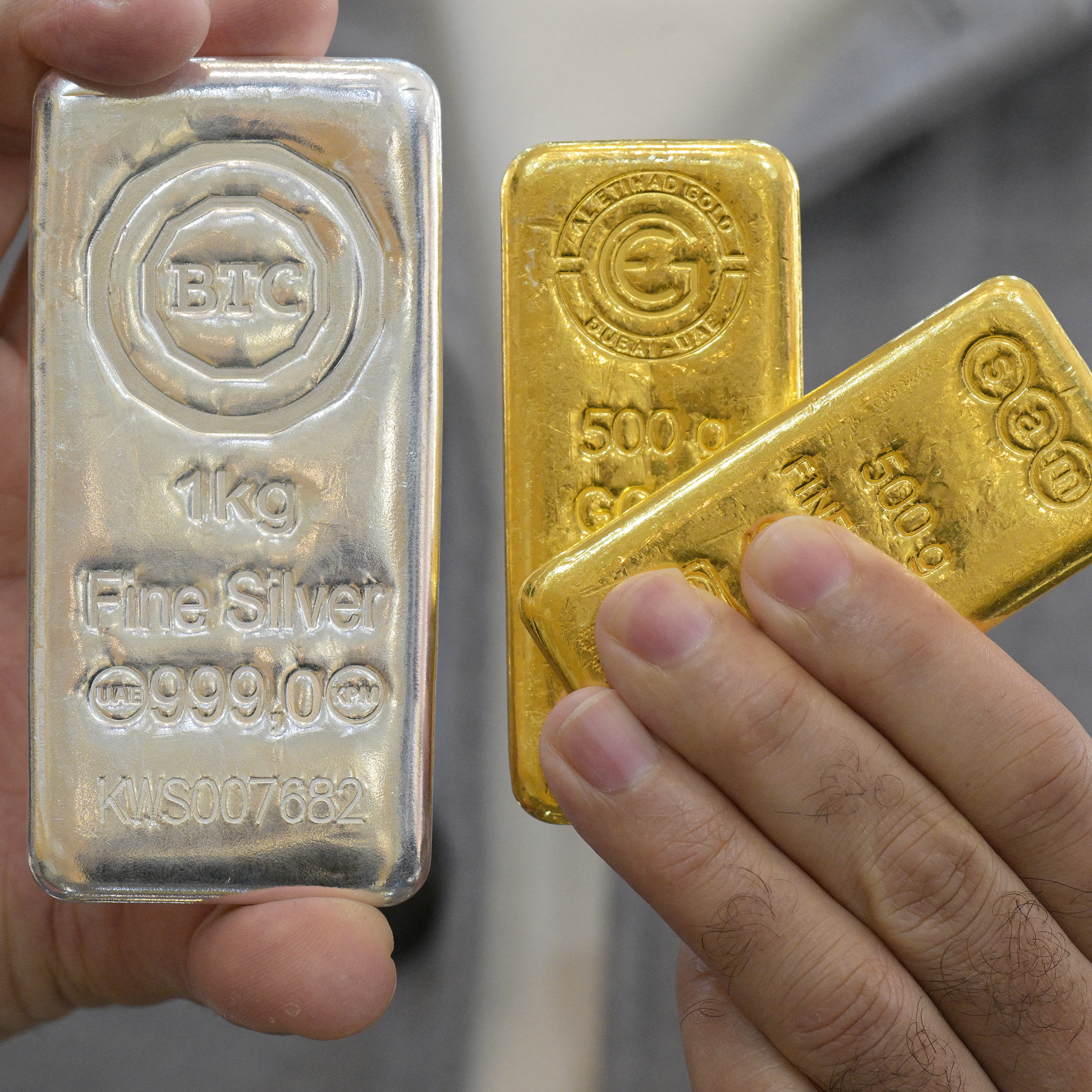
    So this is a fact that just is so memorable. All the gold that's been mined throughout history can fit in about three Olympic sized swimming pools.
    7:33
    Enough for Scrooge McDuck to dive into, but not so much for the rest of the world. Darian. Yes, and these mining companies can't easily find more gold.
    7:42
    The supply of gold, which is the new mining supply, is very insensitive to prices. So even though prices have gone up dramatically, the mining production has not gone up.
    7:54
    Add those bets to institutional money buying up a desirable limited asset, and you've got the bull run we're seeing today.
    8:01
    The question now is if this run can last. Is this time different?
    8:06
    Because over very long periods of time, not years or even decades, but centuries, the value of gold is actually relatively stable.
    8:15
    We obtained data on what Roman centurions were paid 2,000 years ago, and it's remarkable. In gold, they were paid 38 ounces a year. And that translates today to the wage of a U.S. army major.
    8:34
    So that amount of gold they would get paid is worth around $140,000 today. It's pretty spot on for a 2,000 year currency measurement and that means that the long term real return of gold, as in what it's worth after stripping away inflation is roughly zero.
    8:54
    So two things are true. The price of gold is relatively stable in the long term like centuries but gold can go up and down a lot over shorter periods of time. So let's recap what's causing the gold boom. It's a wave of new buyers from foreign central banks to China's insurance industry to speculators betting on a potential rule change for commercial banks.
    9:16
    Is it going to last? Who knows? As Campbell believes this is a significant economic shift that we're seeing. It all depends on things like whether de dollarization continues and I suppose Basel iii.
    9:29
    I think I'm gonna make a trip to Costco.
    9:31
    You're gonna pick up a gold bar?
    9:33
    No, I just need paper towels.
    9:35
    Fair this episode was produced by Corey Bridges with engineering by Maggie Luthor. It was fact by Sierra Juarez. Caitan Cannon edits the show and the indicator is a production of npr.
    9:46
    Sam.

    Why is everyone buying gold?

    0:00
    0:00

    Related Episodes

    What is going on with gold and silver?

    What is going on with gold and silver?

    Feb 11, 20269 min
    GoldSilverPrecious Metals
    Can Europe sell America?

    Can Europe sell America?

    Jan 27, 202610 min
    TrumpGreenlandEU Anti-Coercion Mechanism
    Is Greenland really an untapped land of riches?

    Is Greenland really an untapped land of riches?

    Jan 21, 20269 min
    GreenlandDonald TrumpGreg Barnes
    Why China pulled the plug on Japan

    Why China pulled the plug on Japan

    Jan 5, 20269 min
    Sanae TakaichiChinaJapan