The Indicator from Planet Money
ExplorePodcast overview and latest content
EpisodesBrowse the full episode archive
TopicsDiscover episodes by category
PostsBrowse published articles & write-ups

Podcast

  • Explore
  • Episodes
  • Topics
  • Posts

Recent Episodes

  • Want a 2.5% mortgage? Buy it.
  • The anxiety rattling China’s youth
  • Why Paramount went looney tunes for Warner Bros.
  • Should the families of organ donors be compensated?
  • ICE is bad for business, heat is bad for coffee, and sci-fi is bad for markets

Links

  • Apple Podcasts
  • Overcast

About

The Indicator from Planet Money

The Indicator from Planet Money

A bite-sized show about big ideas. From the people who make Planet Money, The Indicator helps you make sense of what's happening in today's economy. It's a quick hit of insight into money, work, and business. Monday through Friday, in 10 minutes or less.

Powered byPodRewind
    The Indicator from Planet Money
    Episode•September 15, 2025•9 min

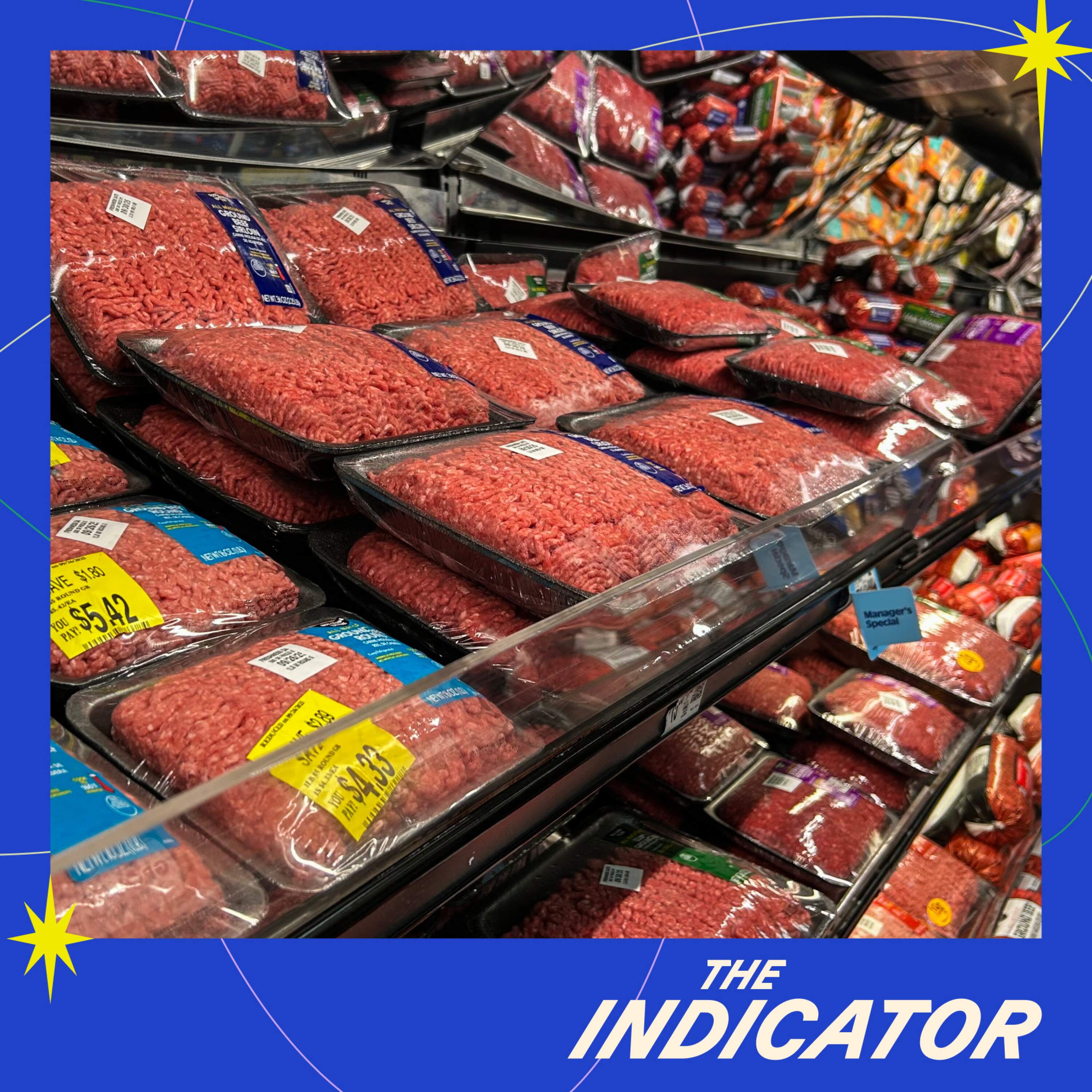
    Why beef prices are so high

    Beef is getting more expensive, and it doesn’t look as though that’s going to change any time soon. That’s the view of the Federal Reserve Bank of Dallas, which wrote in its Beige Book entry this month that the trend of rising beef prices continues. There’s solid demand for beef, but falling supply, as production decreases. Ranchers are making more per cow, but their costs are rising. We speak with a rancher in Wyoming to learn what high beef prices mean for him and other ranchers. Related episodes:  What happened to US farmers during the last trade war (https://www.npr.org/2025/05/14/1251284848/american-farmers-trade-war-tariffs-crops-commodity-credit-corporation)  How USAID cuts hurt American farmers (https://www.npr.org/2025/02/19/1232435535/how-usaid-cuts-hurt-american-farmers) For sponsor-free episodes of The Indicator from Planet Money, subscribe to Planet Money+ via Apple Podcasts or at plus.npr.org (http://plus.npr.org/). Fact-checking by Sierra Juarez (https://www.npr.org/people/1268825622/sierra-juarez). Music by Drop Electric (https://dropelectric.bandcamp.com/). Find us: TikTok (https://www.tiktok.com/@planetmoney), Instagram (https://www.instagram.com/planetmoney/), Facebook (https://www.facebook.com/planetmoney), Newsletter (https://www.npr.org/newsletter/money).   To manage podcast ad preferences, review the links below: See pcm.adswizz.com (https://pcm.adswizz.com) for information about our collection and use of personal data for sponsorship and to manage your podcast sponsorship preferences. Learn more about sponsor message choices: podcastchoices.com/adchoices (https://podcastchoices.com/adchoices) NPR Privacy Policy (https://www.npr.org/about-npr/179878450/privacy-policy)

    Apple PodcastsOvercast

    Transcript

    0:00
    Npr.
    0:11
    Hey, Robert, looks like you just went to the grocery store. Will you show me your haul?
    0:16
    Yes. I decided to buy all the items mentioned in the most recent Beige Book.
    0:22
    Good list. The Beige Book is our favorite obscure government document here at the indicator. It gives insight into how local economies are doing. And Robert, you went super local. Hyper local.
    0:34
    Yeah. Of course. The Beige Book says that beef prices are up, so I bought some hamburger and eggs and dairy products. They're cheaper in some places, according to the Beige Book, so I got a deal on those.
    0:46
    And what's that peeking out of your bag? Corn.
    0:49
    I did get a few cobs. The book says that corn prices are down. The only question now is, can you make a Beige Book recipe with this stuff?
    0:57
    You know, if you have one of those newfangled fridges that you connect to WI fi, it tells you what to make with the random stuff ins. I feel like it would tell you make a really strange frittata.
    1:07
    Frittata is always the answer when you don't know what to make. Just throw it all in there.
    1:11
    A frittata is hearty. And I think we're gonna need some sustenance to get through today's episode, which
    1:17
    is, of course, it's the Beiji Awards, our eight times a year salute to the art and science of telling stories about the economy. I'm Robert Smith.
    1:28
    And I'm Waylon Wong.
    1:30
    It is a fascinating moment in the economy right now.
    1:33
    When is it not, though, Robert?
    1:34
    True, true. We have a labor market that seems frozen, inflation sneaking in around the edges, and there are great stories from inside our refrigerator. We'll hear those ahead on the Beije Awards after the break. I always like to remind people how this award show works. There are 12 regional banks in the Federal Reserve System. Each one studies their local economy and brings back stories of what they see. They publish them in the document known as the Beige Book. We read it and we give awards to the best stories.
    2:06
    Let's start with a runner up. This short sentence appeared in the Beige Book entry for the New York Fed.
    2:13
    Quote, alcohol sales were slow during the summer.
    2:18
    Ernest Hemingway writing these for the Fed.
    2:20
    Now I know. And Hemingway loved his alcohol, right? So I pulled this as a runner up because New York City is all about cocktails in the summer. And we've seen other issues of the Beige Book mention this new long term trend. People are drinking less. A recent entry from the San Francisco Fed said that wine sales were down and some winemakers were removing their vines.
    2:44
    Oh, what vintage goes with that weird frittata?
    2:47
    We made red. It's always red, whatever it is.
    2:50
    Yeah.
    2:51
    All right, let's do the big award.
    2:53
    Okay. Envelope, please. And the beige award goes to the Dallas Fed.
    3:04
    Coming to the stage is Sea, senior business economist for the Dallas Fed, Leila Asani. Congratulations, Laila.
    3:11
    Thank you. On behalf of the Dallas Fed team, we're honored and thrilled to receive the Beiji Award.
    3:16
    You're winning beige book entries about cattle and high beef prices, which we mentioned at the beginning of the show. Do you eat beef or are you one of those notable Texas vegetarians?
    3:26
    Well, I enjoy both. You can call me an equal opportunity eater. So I'll take a plate with Texas brisket on one side and grilled veggies on the other.
    3:36
    Well, we're just coming out of Texas brisket season, the summer. All those barbecues. Is anyone out there talking about beef prices? I hear they've been going up, or so the beige book tells me.
    3:46
    Yes, they certainly have been quite high. And for Texas, the barbecue season runs all 12 months. So whether it's corn on the cobs or ribs, something is always sizzling on the grill in Texas.
    3:57
    It sounds like she works with the Texas Tourism Board. I love it, though. I love it.
    4:01
    Everyone in Texas sounds that way.
    4:04
    The winning entry says, there's some trouble in beef land. Here, I'm going to read it. Cattle prices remained historically high amid solid demand and a decline in beef production. One factor limiting production was the suspension of cattle imports from Mexico, implemented last fall to protect US Livestock from the New World. Screwworm. A parasitic fly.
    4:28
    I know. Sounds scary. So let's break this down. People are still eating a lot of beef, so demand is high.
    4:34
    Is this the age of, you know, Instagram and TikTok influencers telling us all to eat beef tallow fries?
    4:40
    Yeah, right. But the supply of beef is down for a bunch of reasons. There are long term reasons and new challenges. So, Layla, I know that the number of cows and bulls grazing out there in America has been gradually going down.
    4:54
    So cattle inventory in the US has been declining since the mid-1970s. But that trend has become a bit more pronounced over the past few years due to persistent droughts, higher feed costs, and other economic pressures leading ranchers to liquidate their beef herds.
    5:12
    In other words, kill the cattle and send them to market. But there is still not enough beef in the United States for American appetites. So we fill the gap by importing quite a bit of meat from places like Canada and Mexico. But, Leila, you mentioned in the beige book, this infestation, the new World Screwworm has kept out the Mexican beef imports,
    5:33
    and that means fewer cattle are coming into the United States, which results in tighter supply and higher beef prices.
    5:40
    That's bad news for consumers, but not a bad situation for the people who raise cattle. We know this is a nationwide issue, so we called up a rancher out on the range, a little north of
    5:50
    Texas, Wyoming, to be precise, to a guy with a honest to goodness cowboy hat and a beefy name.
    5:58
    My name's Jack Berger. I'm a rancher from Saratoga, Wyoming. And I understand we're going to be talking about cattle prices today.
    6:06
    We are. You know, someone once told me it's rude to ask someone how many heads of cattle they have. So what, what should I ask instead? What's a more polite question?
    6:16
    Well, there's no sense just beating around the bush. We run about 1300 cows, so it's enough to keep us busy.
    6:24
    Anyway, Jack explained to us that, yes, the drought and the screwworm parasite have reduced cattle supply and sent up cattle prices. But there is another factor, something he calls the cattle cycle.
    6:36
    Well, I mean, a few years ago that cattle prices weren't very good. It wasn't very profitable. And that causes some people to kind of leave the business. And those that of us that stay in the business, there's fewer of us and fewer cattle out there on the market. And so that drives prices up.
    6:54
    The cattle cycle happens because cows don't respond immediately to supply and demand. Jack says it would take five years to increase his herd. You have to have the baby calves born after all, and they have to grow up and become meaty, I guess. And who knows what the cattle prices will be in five years. The high prices today might mean, we don't know, there might be a glut of cows by 20, 30.
    7:18
    Of course, high prices now means that Jack is bringing in more money this year. But even then, there is a catch.
    7:25
    Well, you know, there's more profit, but this is our chance to upgrade equipment and make some capital improvements that in the short years, you're not able to do some of that stuff. So, yeah, we got more income. But our costs, our fuel, our tires, our fertilizer have gone up the last few years, and that affects us, too.
    7:45
    Naturally, we had to ask about tariffs. High tariffs might mean even more pressure on prices. But Jack sees the beneficial side of the tariff war. Australia, for instance, used to restrict the import of US Beef. Under pressure from President Trump, Australia has relented.
    8:01
    Yeah, I mean, now Australia's finally taking some beef. I hear they just didn't want ours because it's so much higher quality. They didn't want their people to know how good beef could be and stuff. But they are taking some of our beef now, which is only fair.
    8:18
    That's probably just a story told by cattle ranchers in the U.S. well, maybe. You got to admit.
    8:22
    Well, I don't think there's any country that can claim the quality that we have in the United States.
    8:27
    Always be selling. Always be selling the beef.
    8:29
    He's going for that set of steak knives. Am I right, Robert?
    8:32
    Exactly.
    8:34
    Thanks again to the Dallas Fed for alerting us to this change in supply and demand. And Leila Sani, congratulations for winning the Beiji.
    8:42
    Thank you for having me, Layla.
    8:44
    I feel like every time the Dallas Fed wins, it's for an entry about oil or cattle. I hope we're not stereotyping Texas too much.
    8:51
    I hope so. Not. I think we'll try to find some better anecdotes to include in better sections.
    8:59
    This episode was produced by Cooper Katz McKim and engineer by Kwesi Lee. It was fact checked by Sarah Juarez and edited by Paddy Hirsch. Caking Cannon is our show's editor and the indicator is a production of N.

    Why beef prices are so high

    0:00
    0:00

    Related Episodes

    How Iran's flagging economy inflamed its protests

    How Iran's flagging economy inflamed its protests

    Feb 17, 20269 min
    Iran ProtestsGrand BazaarIranian Rial
    Pay transparency. The WhatsApp and Instagram decision. Our beef with screwworms.

    Pay transparency. The WhatsApp and Instagram decision. Our beef with screwworms.

    Nov 21, 20259 min
    Pay TransparencyWage IncreaseColorado
    Is the Panama Canal a rip-off?

    Is the Panama Canal a rip-off?

    Mar 5, 20259 min
    Panama CanalDonald TrumpPanama Canal Authority